
What if the life you’re living right now isn’t your first draft—just the latest edition? Across cultures and centuries, people have described oddly specific flashes of other times: a childhood “memory” of a place they’ve never visited, an unexplainable skill that seems to arrive pre-installed, or a deep emotional pull toward a certain era for no practical reason.
Skeptics call it imagination, pattern-seeking, or cultural influence. Believers call it reincarnation. Either way, the experiences themselves are real to the person having them—and they often change how someone understands fear, talent, relationships, and purpose.
Past-life recall, in practice, usually doesn’t look like a full movie with opening credits. It’s more like a handful of vivid scenes, sensations, symbols, or emotions that surface when the mind is quiet and the body feels safe.
The goal isn’t to “prove” anything to the internet (the internet is busy anyway). The goal is to explore what your subconscious might be holding—and whether those impressions offer insight into the patterns you keep repeating.
Below are six techniques drawn from popular past-life recall approaches—grounded, structured, and surprisingly practical for something that sounds like it belongs in a fantasy novel.
Past Lives 101: What People Mean When They Talk About “Recall”
In most spiritual traditions that include reincarnation, the basic idea is simple: the soul experiences multiple lifetimes in different forms, carrying forward lessons, tendencies, and unfinished themes. Hinduism and Buddhism have long frameworks for rebirth and karma. Other schools of thought—mystical, esoteric, and even modern metaphysical communities—describe reincarnation as a kind of ongoing education.
But past-life recall isn’t only about belief. Many people report experiences that feel like memory: unfamiliar scenes, languages, or identities that carry strong emotion. Some describe sudden “downloads” of knowledge—how to do something they never learned.
Others notice powerful connections to certain cultures or historical periods. And while mainstream science hasn’t definitively proven reincarnation, researchers and clinicians have documented numerous anecdotal cases—especially reports from young children—that remain difficult to explain in ordinary terms.
What is past-life work actually for? Not for bragging rights (“I was royalty,” says everyone). The most constructive use is self-understanding:
-
Why does a certain situation trigger a disproportionate fear?
-
Why does a place feel like home when you’ve never been there?
-
Why do you repeat the same relationship dynamic like it’s a subscription you forgot to cancel?
“The past isn’t always behind you. Sometimes it’s under your skin.”
If you approach recall as an inner investigation—curious, grounded, and humble—you’re more likely to find meaning instead of chasing dramatic storylines.
What Counts as a Past-Life Memory, Really?
A common misconception is that past-life recall must be a crystal-clear, historically verifiable scene. In reality, most experiences fall into a few repeatable categories: images, emotions, body sensations, and recognition. Think of it like dreaming: your mind communicates in symbols, fragments, and feelings—not always in neat timelines.
A helpful way to stay balanced is to treat what arises as information with a hypothesis, not a verdict. If you “see” yourself on a ship in a storm, the literal ship matters less than what it stirs—fear, grief, courage, separation, survival. The subconscious often speaks in themes.
Here’s a quick guide to what people commonly report:
| What shows up | What it might mean |
|---|---|
| Sudden vivid scenes (faces/places/clothing) | Symbolic memory fragments or deep imagination with emotional truth |
| Strong body sensations (tight throat, aching knee, warmth) | Somatic “imprints” tied to fear, trauma, or intensity |
| Emotional waves (grief, nostalgia, panic, love) | A theme that still shapes attachment and reactions today |
| “Knowing” without learning (skills, language patterns, familiarity) | Intuition, hidden learning, or a sense of continuity |
| Powerful resonance with an era/culture | Identity threads, values, or unresolved curiosity |
Two notes before you begin:
-
Don’t force it. Straining for results is the fastest way to get…creative fiction.
-
Stay kind to your nervous system. If anything feels overwhelming, stop, ground yourself, and come back later.
If you want more guided practices like these (and fewer rabbit holes), subscribe to stay updated—because consistency is what turns “interesting” into “useful.”
1) The Mirror of Time Technique

The Mirror of Time is a visualization practice that uses a familiar image—your reflection—as a bridge into the subconscious. You’re not staring into a mirror hoping for special effects (though if your bathroom lighting is dramatic enough, anything is possible). You’re using the mirror as a portal symbol.
How to do it
-
Find a quiet space and stand or sit comfortably in front of a mirror.
-
Take several slow breaths and relax your shoulders, jaw, and belly.
-
Look softly at your reflection. Then imagine the mirror is not showing “today-you,” but other versions of you.
-
Notice what changes: facial structure, hair, posture, clothing, even the setting behind you.
What to pay attention to
Use details as anchors: fabrics, architecture, accents, objects, emotions. Some people report seeing their face “morph” into other faces; others see scenes unfolding behind them like a film.
Afterward
Write down everything—especially anything that surprised you. The goal is not perfection; it’s signal. Even one consistent symbol repeated over multiple sessions can become a map.
2) Quantum Regression Hypnosis

Quantum regression hypnosis blends traditional hypnosis concepts with the idea that time may be non-linear—experienced as a field of information rather than a straight line. In practice, this method aims to guide you into a deep receptive state where impressions can surface without the usual inner editor interrupting.
What a session looks like
A trained practitioner typically:
-
Guides you into relaxation
-
Uses imagery prompts (light, doors, pathways, “threads” of time)
-
Helps you describe what arises—sensations, visuals, identities, emotions
People often report vivid experiences: a specific historical setting, a role (artist, healer, soldier), or detailed sensory memory. A key feature is felt reality—the emotional intensity can be strong.
Try a simplified at-home version
-
Lie down, close your eyes, and breathe slowly.
-
Imagine floating in a space filled with shimmering “threads” of light.
-
Let your attention drift toward one thread that feels magnetic.
-
Allow images or sensations to rise without judging them.
Important: If you have a history of severe anxiety or trauma, go slowly and consider professional support. This work should feel revealing, not re-traumatizing. Your soul doesn’t need to “prove” anything by overwhelming you.
3) Akashic Records Meditation

In many spiritual traditions, the Akashic Records are described as a “cosmic library”—a symbolic archive containing the story of every soul. Whether you take that literally or metaphorically, the meditation is powerful because it gives the mind a structured place to retrieve information.
The visualization
-
Sit or lie down comfortably.
-
Breathe deeply until your body feels settled.
-
Imagine you’re standing before a massive library that stretches endlessly.
-
Notice the shelves, the glow of the books, the atmosphere.
Then imagine a figure approaching—a librarian, guide, or presence that feels calm. Ask to be shown a “book” connected to a past life that’s relevant now. A book might float to you, or you may be led to a section.
What you might “read”
The pages can appear as words, images, symbols, or even moving scenes. Don’t rush. Ask internally:
-
What lesson is still active?
-
What pattern is repeating?
-
What do I need to release?
Many people find this method strengthens intuitive trust because it feels organized—like your inner world finally has a filing system
4) The Body Memory Scan

The body memory scan treats physical sensation as a doorway. The premise is that intense experiences—especially fear, injury, devotion, or loss—can leave imprints that echo as sensations or unexplained reactions in the present.
How to practice
-
Lie down comfortably and close your eyes.
-
Breathe slowly and scan from head to toe.
-
Notice areas that feel different: tightness, warmth, tingling, heaviness, pulling, numbness.
When you find a sensation, bring gentle attention to it and ask: What memory is connected to this feeling? Then wait. Don’t force an answer.
What can happen
Some people receive a flash: an image of a battlefield, a fall, a fire, a hospital-like setting, a ritual space. Others feel an emotion first—panic, grief, longing—then an image follows.
If something intense surfaces, pause and ground: feel your hands, your breath, the room around you. This is exploration, not punishment. (Your nervous system is not a haunted house attraction.)
Tip: Track recurring sensations over weeks. Patterns are often more meaningful than one dramatic moment.
5) The Dream Incubation Method

Dreams can be a surprisingly direct channel for past-life-style imagery because the conscious mind is offline and the symbolic mind takes over. Dream incubation is the practice of setting a clear intention before sleep—then capturing the results immediately upon waking.
Step-by-step
-
Before sleep, state an intention:
“Tonight I will dream about a past life that holds insight for me now, and I will remember it.” -
Place a notebook and pen next to your bed.
-
When you wake up, don’t move too much. Recall first, write second.
-
Record everything—characters, emotions, locations, objects, weather, colors.
What to look for
Pay attention to dreams that are:
-
unusually vivid
-
emotionally intense
-
historically “styled” (old clothing, different customs, unfamiliar geography)
-
repetitive (same village, same person, same problem)
Dreams may not hand you a neat identity card. Often they offer themes: abandonment, loyalty, escape, responsibility, power, exile, devotion. Over time, you may notice a consistent storyline forming.
6) The Artistic Expression Technique

Sometimes the mind can’t narrate what it knows—but the creative instinct can. Artistic expression uses creation as a form of meditation, bypassing logic and letting the subconscious speak in shape, movement, and symbol.
Choose your medium
Pick what feels natural:
-
drawing or painting
-
sculpting or collage
-
dance or movement
-
music
-
free-writing or poetry
How to do it
-
Set aside uninterrupted time.
-
Breathe and set an intention: connect with a past-life thread that wants to be seen.
-
Create freely—no judging, no planning, no “Is this good?” (That question is the artist’s kryptonite.)
-
Notice what repeatedly appears: landscapes, symbols, faces, architecture, clothing, tools, animals.
Why it works
Creative flow reduces the inner critic and allows intuitive memory to surface. Some people end up making images of places they later recognize from documentaries or historical photos. Others don’t “confirm” anything externally, yet still gain insight because the art reveals emotion and story.
Afterward, title your piece and write a paragraph:
What did it feel like to make this? Who was present? What was happening?
Bonus: The Resonance Recognition Approach

Have you ever felt a strong pull toward a certain time period—ancient Rome, feudal Japan, old coastal villages, medieval castles—without knowing why? Resonance recognition treats those fascinations as breadcrumbs.
How to do it
-
Make a list of cultures, eras, or historical figures you feel deeply drawn to.
-
Write what specifically hooks you: music, philosophy, warfare, spirituality, daily life, clothing, architecture.
-
Immerse yourself: books, documentaries, art, music, museum tours (even virtual ones).
-
Track emotional spikes: chills, tears, déjà vu, sudden “knowing.”
The point isn’t to declare, “Aha! I was Cleopatra’s neighbor’s cousin.” The point is to notice what feels familiar on a soul level—and how that familiarity shapes your identity now. This method is powerful because it blends intellect and intuition: you learn facts while observing inner recognition.
If you reached this far, take it as a sign you’re serious about the work. Keep going—and yes, subscribe if you want more techniques that don’t require dramatic lighting or a fog machine.
Quick Reference Table: Which Technique Fits Which Goal?
| Your goal | Best technique to try |
|---|---|
| Visual scenes and identity clues | Mirror of Time |
| Deep guided recall and structured exploration | Quantum Regression (with a professional) |
| Spiritual symbolism and “soul lessons” | Akashic Records meditation |
| Understanding fears and body-based reactions | Body Memory Scan |
| Ongoing recall over time | Dream Incubation |
| Expressing what can’t be verbalized | Artistic Expression |
FAQs
Is past-life recall safe?
For most people, gentle recall practices are safe when done calmly and slowly. The key is nervous-system awareness: if a method triggers panic, dread, or overwhelm, pause and ground. Choose softer approaches (dream journaling, artistic expression) before deeper ones (hypnosis). If you have a trauma history or mental health concerns, consider professional support and avoid pushing into intense imagery alone. Past-life work should expand insight—not destabilize daily life.
What if I don’t “see” anything?
That’s common. Many people aren’t primarily visual. Your recall may come as emotion, body sensation, or a strong knowing. Start tracking small signals: repeated dream symbols, recurring fascinations, or a consistent feeling during meditation. Also, consistency matters more than intensity—ten gentle sessions often reveal more than one dramatic attempt. Think “slow radio tuning,” not “instant blockbuster.”
How can I tell a real memory from imagination?
You may not be able to prove it with certainty—and that’s okay. A practical approach is to ask: Does this experience bring clarity, healing, or insight? Real or imagined, the subconscious can still reveal truth through symbol. Look for repeating patterns across methods, emotional consistency, and meaningful shifts in your present-life behavior (reduced fear, clearer boundaries, deeper self-understanding).
Conclusion
Past-life recall doesn’t have to be theatrical to be powerful. Most of the time, it arrives quietly: a scene in a mirror, a sensation in the body, a dream that feels too detailed to dismiss, a piece of art that surprises you with its certainty.
Whether you view reincarnation as spiritual reality or psychological metaphor, these techniques offer something valuable—a structured way to explore the deeper layers of memory, identity, and meaning.
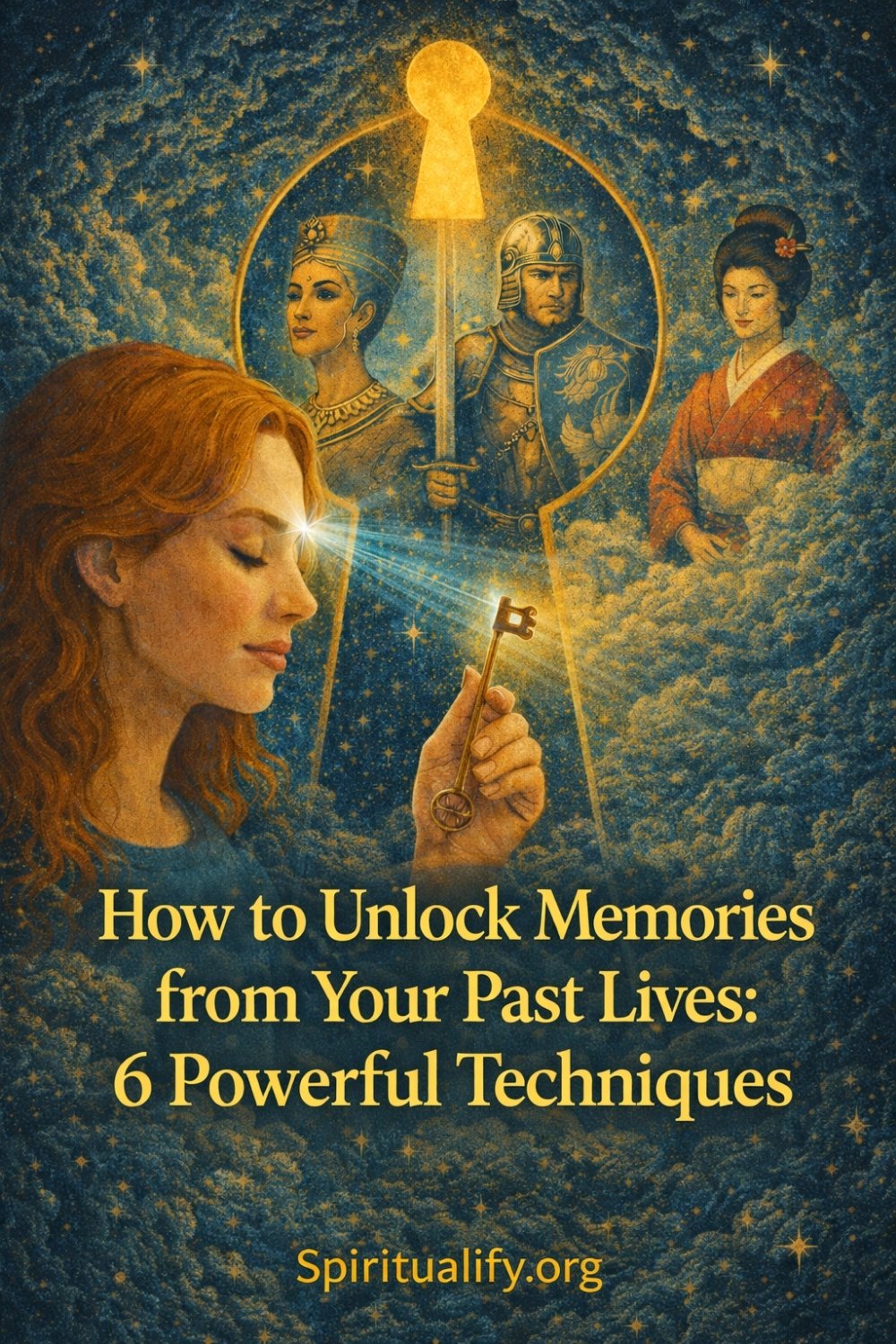
Start with the gentlest method that feels right. Keep notes. Watch for patterns. And remember: the most useful past-life insight isn’t “Who was I?” but “What is this still shaping in me now?” When that question is answered, the present life gets lighter—like a door finally opening where you didn’t realize you were locked.


Having studied energetic healing, counselling, coaching, yoga, and Buddhism, Charles is a teacher of practices that support others to move forward and heal by holistic means.